15 Best SaaS Management Tools for Mid-Sized Companies (2026)
.avif)


.avif)
Short answer: for a company with 100 to 1,000 employees, the best SaaS management tools in 2026 are Corma, Zluri, Torii, Zylo and 1Password SaaS Manager when IT owns the problem, and Vendr, Spendflo or Sastrify when procurement owns it. The right choice depends less on feature lists than on three questions: who runs the tool day to day, whether you need access automation (onboarding, offboarding, access reviews) or only spend control, and whether your data must stay in the EU.
A SaaS management platform (SMP) is software that discovers every SaaS application a company uses, tracks licenses, spend and renewals, and automates access changes such as onboarding and offboarding from one console. Mid-sized companies feel the need first: they have enough apps to lose track of them, but rarely a dedicated SaaS operations team.
This guide compares 15 tools on the same template: what each one is, its key features, pros and cons, pricing model and the team it fits best. Corma publishes this guide and is one of the vendors listed, so every competitor is described from its own documentation, with the limits we think a mid-sized buyer should know.
Updated September 2026. We removed three tools that no longer fit this guide: LicenceOne, Ampliphae SaaSGuard (whose product IP Arqit acquired in 2025) and Airbase (now part of Paylocity, as a spend management product). We added Zylo, 1Password SaaS Manager and BetterCloud, and reflected three 2026 acquisitions: Vendr by Vertice, Sastrify by Deel and BetterCloud by CoreStack.
Key takeaways
- A SaaS management platform covers five jobs in one place: app discovery, license optimization, spend and renewal tracking, access lifecycle automation and compliance evidence.
- Gartner's 2026 Magic Quadrant for SaaS Management Platforms, published on 18 June 2026, evaluates 16 vendors, including Corma, Torii, Zluri, Zylo, Flexera, CloudEagle.ai, BetterCloud and 1Password.
- Procurement platforms such as Vendr, Spendflo and Sastrify focus on negotiating and buying software; where they offer access features, these center on licenses rather than identity lifecycle workflows and access reviews.
- Only three tools in this list state a standard EU hosting option: Corma on all plans, 1Password SaaS Manager and Flexera One; ActivTrak offers an EU data center on request.
- Pricing models differ as much as features: per-user plans grow with headcount, while annual platform fees (Sastrify starts at €12,500 a year) pay off only with a large SaaS budget.
What does a SaaS management platform do?
A SaaS management platform replaces the spreadsheet, the finance export and the offboarding checklist with one system connected to your identity provider, finance tools and SaaS apps. For a mid-sized company, it covers five jobs:
- Discovery: find every app in use, including shadow IT and free tools, from SSO logs, finance data, browser extensions and direct integrations.
- License optimization: spot inactive seats and duplicate tools, then reclaim or downgrade licenses before renewal.
- Spend and renewals: track contracts, owners and renewal dates so nothing renews unnoticed.
- Access lifecycle: create accounts on day one and remove every access on the last day (joiner, mover, leaver).
- Compliance evidence: run access reviews and keep audit logs for ISO 27001, SOC 2 or NIS2.
Not every tool in this list covers all five jobs. You will meet four families of tools:
How we selected and compared these tools
We started from the tools in the previous version of this guide, removed those no longer sold as SaaS management products, and added vendors evaluated in Gartner's 2026 Magic Quadrant for SaaS Management Platforms. Each tool was then checked against its own website, documentation, pricing page and press releases in September 2026. We did not include user ratings, because scores change often and differ from one review site to another.
Every tool is compared on the criteria that matter for 100 to 1,000 employees:
- Fit for mid-sized teams: can an IT team of two to five people run it without a dedicated SaaS operations role?
- Primary owner: built for IT, Security, Finance or Procurement.
- Discovery depth: which sources it uses (identity provider, finance data, browser, API) and whether free apps show up.
- Access automation: onboarding, offboarding and access reviews, not only visibility.
- Pricing transparency: public prices, free plan or quote only.
- Data residency and security: EU hosting option and certifications.
For a step-by-step method, read our guide on how to choose a SaaS management platform. Gartner placements quoted below come from each vendor's own announcement. Gartner does not endorse any vendor, product or service depicted in its research publications.
The 15 best SaaS management tools at a glance
IT-led SaaS management platforms
These ten platforms are built for IT teams. They discover apps, optimize licenses and, in most cases, automate access changes.
1. Corma
Corma is a European SaaS management and identity governance platform that combines software license, contract and access management for small and mid-sized IT teams. It connects to Google Workspace, Microsoft Entra ID, Okta or JumpCloud, discovers apps through the identity provider, a browser extension and finance data, then automates the tasks that usually live in spreadsheets: onboarding, offboarding, access reviews and renewals.
Snapshot: Paris, France. Founded in 2023. Included in the 2025 and 2026 Gartner Magic Quadrant for SaaS Management Platforms.
Key features
- Shadow IT and shadow AI discovery from the identity provider, a browser extension and financial data
- License and contract tracking with renewal alerts and usage-based license reclaim
- Automated provisioning and deprovisioning with joiner, mover and leaver workflows
- Automated access reviews and a self-serve app store for access requests
- EU data residency and encryption in transit and at rest on every plan
Pros
- Covers SaaS management and access governance in one tool, so a mid-sized team does not need two platforms
- Public pricing, with a free plan and per-user paid plans
- EU data residency and ISO/IEC 27001:2022 certification
Cons
- No managed vendor negotiation service, so pair it with a procurement tool if you need one
- Younger vendor than long-established Leaders such as Flexera or Zylo
Pricing: free plan with 10 direct integrations and unlimited users; Essential from €3 per user per month on an annual commitment; Pro and Enterprise on quote. Details on the Corma pricing page.
Best for: mid-sized IT teams that want visibility, license savings and automated access control in one SaaS management platform, without an enterprise-sized project.
2. Zluri
Zluri is an identity governance and administration (IGA) platform with a SaaS management module, built for IT and security teams that need access reviews and lifecycle automation. Since March 2026 it markets the Zluri Identity Security Platform, which adds identity risk scoring on top of discovery, access requests and license optimization.
Snapshot: Milpitas, California, with teams in Bengaluru. Founded in 2020. Named a Leader in the 2024 and 2025 Gartner Magic Quadrant for SaaS Management Platforms and included in the 2026 report.
Key features
- Discovery from SSO, direct integrations, HR, finance, MDM, CASB and browser extension sources
- More than 300 out-of-the-box connectors
- Access reviews, access requests and joiner, mover and leaver automation
- License optimization, a contract repository and blocking of auto-renewals for unused apps
- Identity security posture management for human and non-human identities
Pros
- Deep access governance for audit-heavy environments
- Many discovery sources in a single console
- Broad security certifications (SOC 2 Type II, ISO 27001, ISO 27701)
Cons
- SaaS spend and procurement now come second to identity security
- Quote-only pricing, and more platform than a 150-person company may need
Pricing: quote-based.
Best for: security-led mid-market and enterprise teams in regulated industries that want identity governance first. Compare both approaches in our Corma vs Zluri comparison.
3. Torii
Torii is a SaaS and AI management platform that helps IT teams discover apps, reclaim licenses and automate SaaS operations with no-code workflows and AI agents. It launched Eko, a set of AI agents for SaaS management, in April 2025, and an AI Management platform to control AI spend and shadow AI in May 2026.
Snapshot: New York, USA. Founded in 2017. Named a Leader in the Gartner Magic Quadrant for SaaS Management Platforms in 2024, 2025 and 2026.
Key features
- Discovery that cross-references seven or more data sources
- No-code workflows for onboarding, offboarding, renewals and license reclaim
- Contract and renewal management
- Access requests, access reviews and identity governance modules
- AI agents (Eko) and governance of AI tools
Pros
- Mature automation engine with many deep integrations
- Consistent Leader placement in Gartner's evaluation
- Covers SaaS, identity governance and AI tools in separate modules
Cons
- Quote-only pricing, with entry costs that can be high for a company near 100 employees
- Non-EU vendor, with no EU hosting option stated
Pricing: quote-based, per module (SaaS management, identity governance, AI management).
Best for: scale-ups and enterprises with large, fast-changing SaaS stacks and an IT team ready to build automations. See how the two platforms compare in Corma vs Torii.
4. Zylo
Zylo is a SaaS management platform for enterprise software and AI spend optimization that uses financial data as its main discovery source. Its application catalog, the Zybrary, covers more than 30,000 applications, and the platform tracks licenses, contracts and renewals for IT, procurement and FinOps teams.
Snapshot: Indianapolis, USA. Founded in 2016. Named a Leader in the 2026 Gartner Magic Quadrant for SaaS Management Platforms for the third consecutive year.
Key features
- Spend-based discovery from finance and expense data, plus 61 direct integrations and a usage connector
- License reclamation and consumption monitoring
- Contract ingestion with an AI contract assistant
- Renewal tracking and cost optimization recommendations
- Okta and Entra ID actions and Jira automations on the Premium plan
Pros
- Strong spend analytics for large software budgets
- Large application catalog to normalize vendors and products
- Long track record with enterprise customers
Cons
- Free apps do not appear, because discovery starts from financial data
- Enterprise positioning and quote-only pricing
Pricing: quote-based (Core, Premium and Enterprise plans).
Best for: larger mid-market and enterprise companies where finance and procurement drive SaaS decisions.
5. 1Password SaaS Manager
1Password SaaS Manager is a SaaS management platform, formerly Trelica, that helps organizations discover and secure access to SaaS applications while optimizing spend. 1Password announced its acquisition of the UK-based Trelica in January 2025, and the product is now part of the 1Password Unified Access platform, while remaining available on its own.
Snapshot: parent company based in Toronto, Canada; Trelica was founded in the UK in 2018. Named a Leader in the 2026 Gartner Magic Quadrant for SaaS Management Platforms.
Key features
- Discovery from identity providers, SSO, finance systems, a browser extension and 1Password vaults
- More than 400 integrations
- License optimization, plus AI spend budgets with burn-rate alerts
- Access reviews with one-click revocation and audit exports
- Policy-based provisioning and offboarding
Pros
- Combines SaaS visibility with credential and access security
- EU hosting environment available
- Wide integration catalog
Cons
- Quote-only pricing
- Strongest fit for companies already standardized on 1Password
Pricing: quote-based.
Best for: security-minded IT teams, especially those already using 1Password, that want SaaS discovery and access reviews with EU hosting. Compare it with Corma in Corma vs Trelica.
6. BetterCloud
BetterCloud is a SaaS management platform focused on workflow automation, used by IT teams to automate onboarding, offboarding and security policies across SaaS apps. CoreStack acquired it in March 2026, and it now operates as BetterCloud, a CoreStack Company.
Snapshot: founded in New York in 2011. Named a Leader in the 2025 Gartner Magic Quadrant for SaaS Management Platforms and included in the 2026 report.
Key features
- No-code workflow builder with more than 1,000 workflow actions, triggers and templates
- Automated provisioning, offboarding and security policies
- Discovery, spend optimization and license reclamation
- File governance for Google Workspace
- An AI IT agent for routine requests
Pros
- Long heritage in user lifecycle automation
- Free spend optimization module to get started
- Deep Google Workspace governance
Cons
- More than 100 integrations, fewer than several competitors in this list
- Roadmap may shift during the CoreStack integration
Pricing: Spend Optimization Basic at $0 per month; other modules on quote.
Best for: IT teams that want to automate the user lifecycle and security policies, especially in Google Workspace. See Corma vs BetterCloud.
7. CloudEagle
CloudEagle is an AI governance and SaaS management platform that combines SaaS management, procurement, identity governance and security in five modules. It pairs software with procurement support, including price benchmarking and negotiation help.
Snapshot: California, USA. Founded in 2021 (Y Combinator W22). Named a Niche Player in 2025 and a Leader in the 2026 Gartner Magic Quadrant for SaaS Management Platforms.
Key features
- More than 500 integrations included at no extra cost
- Discovery from SSO logs, finance data, browser activity and security tools
- License harvesting, contract management and renewal alerts at 30, 60 and 90 days
- Procurement intake workflows, price benchmarking and negotiation support
- Continuous access reviews and automatic deprovisioning
Pros
- One vendor for SaaS management and procurement
- Large integration catalog included in the price
- Fast progress in Gartner's evaluation between 2025 and 2026
Cons
- Enterprise-oriented messaging and module-based quotes
- A five-module suite may be more than a mid-sized team needs
Pricing: quote-based, per module.
Best for: companies where IT and procurement want to share one platform for SaaS buying and governance.
8. Lumos
Lumos is an identity governance platform that uses AI agents to govern access for employees, machine identities and AI agents, with SaaS license management as a secondary feature. It is known for its internal app store, where employees request access to tools.
Snapshot: San Francisco, USA. Founded in 2020. Raised a $35 million Series B in 2024. Named a Visionary in the 2024 Gartner Magic Quadrant for SaaS Management Platforms and evaluated again in 2025.
Key features
- Access requests through an internal app store, with just-in-time access
- Access reviews, joiner, mover and leaver automation and role mining
- Governance of non-human identities and AI agents
- Discovery from the identity provider, browser sessions, emails and contracts
- Detection of idle licenses, orphaned apps and redundant tools
Pros
- Smooth access request experience for employees
- Covers machine identities and AI agents
- More than 300 integrations
Cons
- Identity governance first, with renewals and contract workflows less central
- Leans toward upper mid-market and enterprise companies
Pricing: quote-based.
Best for: security and IT teams whose main pain is access requests and access reviews. See Corma vs Lumos.
9. Flexera One SaaS Management
Flexera is an IT asset management and FinOps vendor whose Flexera One SaaS Management product manages SaaS alongside cloud and on-premises software. Flexera acquired Snow Software in February 2024 and launched a unified SaaS management product in July 2025.
Snapshot: Itasca, Illinois, USA. Company roots going back to 1987. Named a Leader in the 2025 and 2026 Gartner Magic Quadrant for SaaS Management Platforms.
Key features
- SaaS and AI discovery through financial data, APIs, a browser extension, SSO, CASB and agents
- Usage insights for approved and shadow apps
- Optimization recommendations, renewal and contract management
- AI-based contract ingestion and shadow AI detection
- One view of SaaS, cloud and on-premises software licenses
Pros
- Covers the full software estate, not only SaaS
- EU hosting region for Flexera One
- Deep license compliance expertise
Cons
- Breadth and implementation effort can be heavy for 100 to 1,000 employees
- Two platforms, Flexera One and Snow Atlas, are still being merged
Pricing: quote-based.
Best for: larger organizations with a software asset management team and a mix of SaaS, cloud and on-premises licenses. For lighter options, see our list of software license management tools.
10. Megazone PoPs (SPACE SaaSOps)
Megazone PoPs is a SaaS management platform from South Korea's MegazoneCloud, now sold under the name SPACE SaaSOps, that tracks SaaS costs, contracts and licenses with plans sized from 100 to more than 1,000 users. The product is available in Korean, English and Japanese.
Snapshot: MegazoneCloud, South Korea. Launched in September 2024. Named a Niche Player in the 2025 Gartner Magic Quadrant for SaaS Management Platforms.
Key features
- Discovery through OAuth and SSO integrations
- Cost tracking by user and by app, with duplicate detection
- Contract and subscription management with renewal forecasting
- Directory sync on all plans, with user provisioning and revocation from the Professional plan
- Single sign-on for connected SaaS apps over SAML 2.0, OAuth and OIDC
Pros
- Free plan for up to 100 users
- Paid tiers sized for up to 300 and up to 1,000 users
- Strong fit for Asia-Pacific operations
Cons
- Limited presence in Europe
- Provisioning requires the Professional plan or above
Pricing: free for up to 100 users; Essentials, Professional and Enterprise plans on quote.
Best for: companies with operations in Asia-Pacific, or small IT teams that want to start with a free plan.
Procurement-led SaaS buying platforms
These three tools help finance and procurement teams buy software for less. Where they offer access features, these center on licenses rather than onboarding workflows and access reviews, so IT-led teams usually run them alongside a SaaS management platform. For a deeper comparison of this category, see our guide to SaaS spend management software.
11. Vendr
Vendr is a software buying and negotiation platform that uses pricing data and an AI negotiation agent called Ruth to help finance and procurement teams pay less for software. Vertice, a London-based procurement company, acquired Vendr in June 2026.
Snapshot: Boston, USA. Now part of Vertice. Free pricing benchmarks compiled from more than $4 billion in software purchases.
Key features
- Ruth, an AI agent that advises on negotiations or runs them
- Free price checks and pricing benchmarks
- Contract analysis
- Access to Vertice's intake-to-procure platform for Vendr customers
Pros
- Large pricing dataset to prepare negotiations
- Free entry point for price checks
- Automated negotiation with human oversight
Cons
- No SaaS discovery, usage analytics or access management
- Product and brand roadmap still settling after the acquisition
Pricing: free price checks; paid plans on quote.
Best for: finance and procurement teams with large renewals to negotiate. Compare it with Corma in Corma vs Vendr.
12. Spendflo
Spendflo is an AI-native intake-to-pay procurement platform for mid-market companies that also tracks SaaS licenses and offers negotiation by expert buyers. In May 2026 it launched Flo AI, a set of agents for procurement, contracts and accounts payable.
Snapshot: San Francisco, USA. Reports $3.7 billion in software spend processed on its platform.
Key features
- Intake and approval workflows (Flo Procure)
- Contract and renewal management (Flo Contracts)
- Accounts payable automation (Flo AP)
- Shadow IT detection, license tracking and license deprovisioning when employees leave
- Negotiation by dedicated procurement experts
Pros
- Built for mid-market companies with $50 million to $1 billion in revenue
- Combines software with human negotiation
- Covers the buying process from request to payment
Cons
- SaaS license management is secondary to procurement
- Personal data is mainly processed in the United States
Pricing: quote-based (Grow, Scale and Enterprise plans, each priced as a platform fee plus a fee per completed request).
Best for: procurement-led mid-market companies that want to centralize every software purchase.
13. Sastrify
Sastrify is a SaaS procurement and management platform that combines software discovery and renewal workflows with pricing benchmarks and expert negotiation. Deel announced its acquisition of Sastrify in May 2026 and is folding the product into Deel IT.
Snapshot: founded in Cologne, Germany, in 2020. Benchmarks cover more than 15,000 vendors, according to the company.
Key features
- Discovery, shadow IT detection and usage analytics
- Renewal workflows and contract tracking
- AI pricing benchmarks
- Expert procurement with a dedicated negotiator
- Compliance and vendor risk checks
Pros
- Public starting prices
- European roots and a GDPR focus
- ROI guarantee on the Expert Procurement plan
Cons
- Entry price is significant for companies near 100 employees
- Product and brand continuity uncertain during the Deel integration
Pricing: Software Management from €12,500 per year, Vendor Benchmarks from €15,000 per year, Expert Procurement from €25,000 per year.
Best for: European companies with a large SaaS budget that want negotiation handled for them. See Corma vs Sastrify.
Adjacent tools for specific needs
These two tools often appear next to SaaS management platforms, but they solve a different problem. They make sense only if their core use case matches yours.
14. Beamy
Beamy is a French AI-driven business transformation platform that helps large enterprises map application usage, govern shadow IT and decide which apps to keep, retire or replace. It targets organizations with tens of thousands of employees.
Snapshot: France. Founded in 2017. Runs on Google Cloud.
Key features
- Usage intelligence across business units and subsidiaries
- Shadow IT and adoption mapping
- App portfolio decisions: invest, retire or replace with AI
- Usage data to prepare renewal negotiations
- Connectors to CMDB, cloud security and enterprise architecture tools
Pros
- Built for decentralized groups with many entities
- Privacy-first design with pseudonymized processing
- European vendor
Cons
- Aimed at large enterprises rather than companies with 100 to 1,000 employees
- Focused on portfolio governance rather than provisioning or offboarding
Pricing: quote-based.
Best for: mid-sized subsidiaries of large groups that report into a group-wide application governance program.
15. ActivTrak
ActivTrak is a workforce analytics platform that measures how employees use applications and websites, with a SaaS management use case for finding inactive accounts, unused licenses and overlapping apps. Its data comes from an agent installed on each device.
Snapshot: Austin, Texas, USA. Founded in 2009. Used by more than 9,500 organizations, according to the company.
Key features
- App and website usage tracking by employee and team
- Reports on inactive accounts and unused licenses
- Technology license optimization report (requires the ActivConnect add-on)
- Productivity and workload analytics
- AI Insights add-on
Pros
- Public pricing with a free plan
- Detailed usage data, including desktop applications
- EU data center available on request for paid accounts
Cons
- Requires an endpoint agent and raises employee monitoring questions in the EU
- License and cost data must be entered by the customer, with no provisioning or renewal workflows
Pricing: free for up to 3 people; paid plans from $10 to $21 per worker per month, billed annually.
Best for: operations teams that already measure productivity and want usage data to support license decisions.
SaaS Spend Management
Spendesk
Spendesk is a European spend management platform that combines corporate cards, invoice management, purchase orders, employee reimbursements, and spend analytics in one procure-to-pay workflow. It is built for finance teams at companies with 50 to 1,000 employees and serves more than 200,000 users across Europe, the UK, and the US, with over €20 billion in company spending processed to date. On the SaaS side, Spendesk sits upstream of discovery: purchase requests, approval routing, and single-use virtual cards stop unsanctioned subscriptions before they enter the stack and quietly turn into renewals.
Pros
- Native procure-to-pay workflow with No PO, No Pay enforcement, multi-step approvals, and 3-way matching
- Single-use virtual Mastercard cards for one-off online purchases, which cuts off a common source of zombie SaaS subscriptions
- FCA and ACPR licensed as a regulated European payment institution, with GDPR, ISO 27001:2022, PCI-DSS, PSD2, and DORA compliance
- Integrations with Xero, QuickBooks, Sage, NetSuite, DATEV, Microsoft Business Central, Workday, BambooHR, Personio, HiBob, Okta, and Azure AD
Cons
- Not a dedicated SaaS discovery tool, so it complements rather than replaces app-scanning platforms
- No free tier; onboarding averages around six weeks for larger setups
Unique Advantage
Spendesk governs SaaS spend at the point of purchase, not after the fact. Prepaid Mastercard cards (virtual card limits up to €200,000 per transaction for EEA customers, physical up to €50,000), No PO, No Pay enforcement, and international invoice payments via Wise Platform in 30+ currencies give finance teams control before money leaves the company, rather than reconciling it from card statements at month-end.
Best For
Mid-market European finance teams (50 to 1,000 employees) running multiple entities and currencies, who want SaaS spend, procurement, and AP handled in one workflow alongside their SaaS management stack.
Quick FAQs
Does Spendesk replace a SaaS discovery tool?
No. Spendesk controls how SaaS gets bought and paid for, so it pairs with discovery platforms that scan the network for shadow IT.
How does Spendesk help reduce zombie subscriptions?
Single-use virtual cards expire after the transaction, so lapsed trials and forgotten tools cannot silently keep charging. Purchase orders and approval workflows catch new subscriptions before the first payment.
Is Spendesk compliant for UK and European finance teams?
Yes. Spendesk is FCA and ACPR licensed, offers HMRC-compliant invoice archiving for UK teams, DATEV integration for German entities, and EU-native VAT handling.
Which SaaS management tool fits your situation?
Start from the problem you need to solve first, then shortlist two or three tools:
With fewer than 100 employees, the priorities change: a complete app inventory and clean offboarding matter more than advanced workflows. Our guide to SaaS management for small businesses covers that stage.
Why Corma for mid-sized IT teams
Most tools in this list were built either for spend or for identity. Corma was built for the mid-sized company where the same two to five people handle both: the IT team that buys the licenses, onboards new hires, removes access on the last day and answers the auditor.
- SaaS and access in one platform: discovery, license optimization, renewals, provisioning and access reviews without a second tool.
- Connected to the identity provider you already use: Google Workspace, Microsoft Entra ID, Okta and JumpCloud.
- European by design: EU data residency on every plan, GDPR compliance and ISO/IEC 27001:2022 certification.
- Recognized by Gartner: included in the Gartner Magic Quadrant for SaaS Management Platforms in 2025 and 2026.
- Fast time to value: most mid-sized companies are live in under a month, and Corma customers can reduce SaaS costs by up to 30%.
- Transparent pricing: a free plan, then per-user plans from €3 per user per month.
Teams such as Brevo, Skello and Apgar use Corma to run SaaS and access management. Book a Corma demo to see how it maps your own SaaS stack.
FAQ
What is the best SaaS management platform for a mid-sized company?
For most companies with 100 to 1,000 employees, the best SaaS management platform covers discovery, license optimization and access automation without needing a dedicated operations team. Corma, Torii, Zluri, Zylo and 1Password SaaS Manager are the strongest IT-led options in 2026. Corma adds public per-user pricing and EU data residency, which suits European mid-sized companies.
How much does a SaaS management platform cost?
Prices range from free plans to annual contracts above €25,000. Corma and Megazone PoPs offer free plans, Corma's paid plans start at €3 per user per month, ActivTrak publishes prices from $10 per worker per month, and Sastrify starts at €12,500 per year. Most other vendors, including Torii, Zluri, Zylo and Flexera, price on quote.
What is the difference between a SaaS management platform and SaaS spend management software?
A SaaS management platform manages the whole app lifecycle: discovery, licenses, renewals and user access. SaaS spend management software focuses on cost, with benchmarks, negotiation and purchasing workflows. Many mid-sized companies start with a SaaS management platform and add a spend or procurement tool when renewals become large.
Does a SaaS management platform replace Okta or Microsoft Entra ID?
No. An identity provider handles sign-in and single sign-on, while a SaaS management platform uses the identity provider's data to find apps, track licenses and automate provisioning, including for apps that are not connected to SSO. The two work together.
What is the best SaaS management platform for remote companies?
Remote companies need discovery that does not depend on an office network, and offboarding that closes every account on the last day. Look for identity provider integration, a browser extension to detect shadow IT and automated deprovisioning. Corma, Torii and 1Password SaaS Manager cover all three.
Which SaaS management tools offer EU data residency?
In this list, Corma states EU data residency on all plans, 1Password SaaS Manager runs an EU hosting environment and Flexera One offers an EU region. ActivTrak can store data in an EU data center on request. Most US vendors do not state an EU hosting option on their websites.
Is there a free SaaS management tool?
Yes. Corma has a free plan with 10 direct integrations and unlimited users, Megazone PoPs is free for up to 100 users, and BetterCloud offers a free spend optimization module. Free plans cover visibility; automation such as provisioning and access reviews usually requires a paid plan.
Which vendors are Leaders in the 2026 Gartner Magic Quadrant for SaaS Management Platforms?
According to the vendors' own announcements, Torii, Zylo, Flexera, CloudEagle.ai, 1Password and Calero were named Leaders in the report published on 18 June 2026. Corma, Zluri, BetterCloud and Josys are among the 16 vendors evaluated.
%20as%20a%20mid-market%20IGA.avif)
Is C1, formerly ConductorOne, right for mid-market IGA? Pricing, coverage and alternatives


Okta pricing 2027: real cost per user, hidden fees and what mid-market teams pay
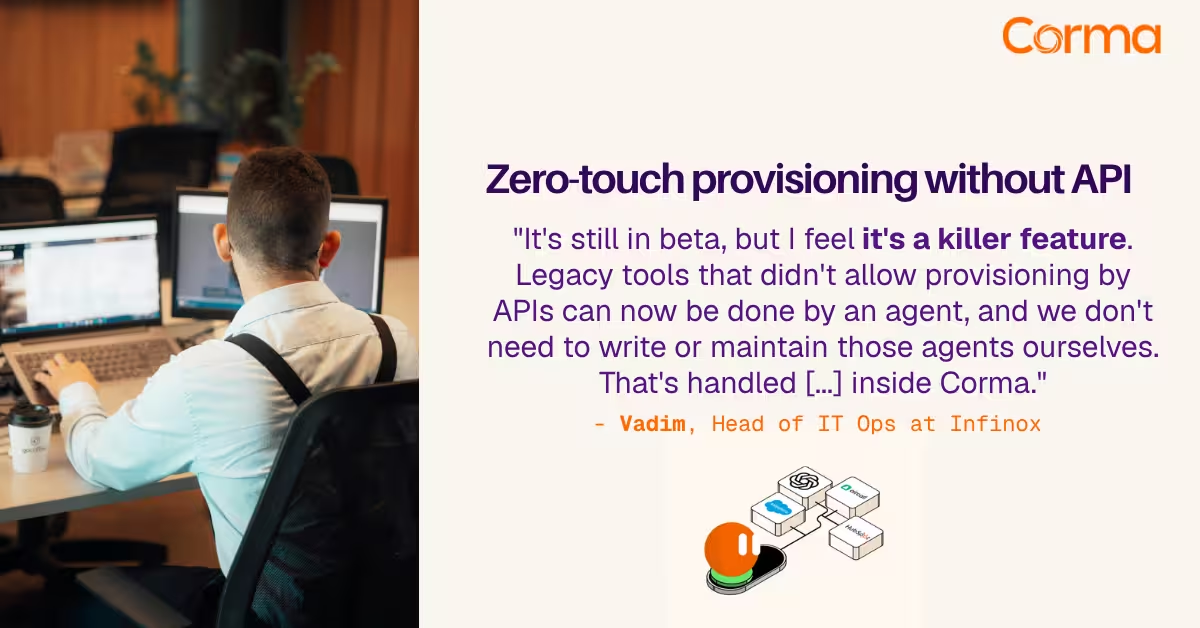
Corma’s custom agents in action at Infinox
The new standard in license management
Ready to revolutionize your IT governance?